World War II Memorial

The World War II memorial was not built entirely from scratch. Prior to the memorial’s manifestation, the Rainbow Pool was the resident of the land, perfectly situated between the Lincoln Memorial and the Washington Monument, both of which honor our most significant American forefathers. Thus, the Rainbow Pool served as an important intersection of reflection. It is of no small consequence, therefore, that one of our nation’s—and the world’s— most significant war be made to serve as a memorial on the very spot that housed the Rainbow Pool. As such, it is no surprise that the pool remained as a central point as construction of the World War II memorial was commenced in 2001. As we enter the memorial, we see it is structured as an open amphitheater of sorts surrounding the Rainbow Pool and the entire pavilion. It lends me to believe that it remains a place of reflection, a place to think on our past and our victories and losses.

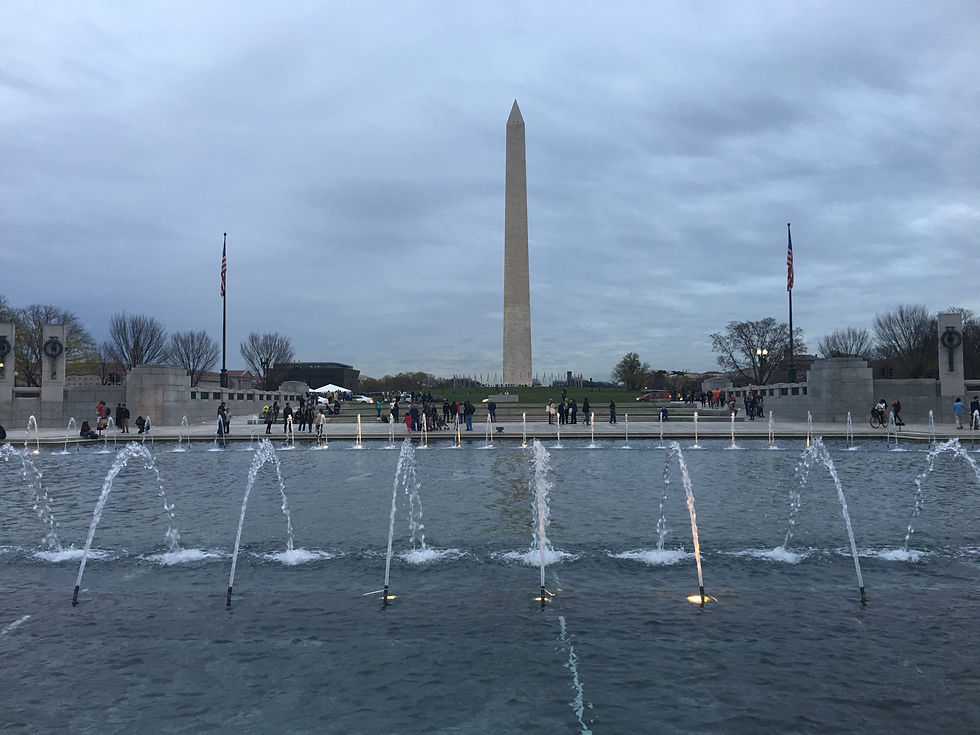

From my observations, most memorials, say, the Lincoln memorial, don’t have park rangers or an information desk. The World War II memorial has a dedicated information building as well as park rangers. This leads me to believe that the war memorial was thought to require more attention than any other memorial such as a museum would need. I don’t recall seeing any security but I am sure there must be - it is one of the more significant memorials in the DC area. Security must have had a different set of priorities, for in a typical museum you don’t really see people touching things, but this memorial lends to tactile interaction.

As fate would have it, I ran into none other than a World War II veteran, senator, and former presidential candidate, Bob Dole. It was from him that I learned that he was part of the commission to start a war memorial. Very exciting.


At the Western side of the memorial is the Freedom Wall with the inscription, “Here We Mark the Price of Freedom.” One of the main ideologies of which our country is built on is the concept of freedom. Freedom is the core of American life. Without freedom of religion, speech, assembly, choice, justice, etc., our country would be no different from the oppressive states from which our forefathers fled. Thus, defending our freedom is our country’s most vital mission. Unfortunately, in protecting this right the loss of human life becomes a consequence, “the price of freedom.” Several gold stars line the Freedom Wall representing 100 lives each that were lost to the war. The gold carries on a tradition practiced by American families during the war. When their men were drafted into the war, American families proudly displayed a blue star in the window. If the unfortunate news came that their loved ones were gone, the blue star was replaced by a gold star. Gold is the color of prestige and honor. Interesting to note, however, that the stars are not actually made of gold, but of stainless steel! This brings up a question—if we really wanted to honor our veterans, why wouldn’t we use real gold? Is it a structural benefit or was it merely due to lost funds?
To the left and right of the Freedom Wall, and forming two semi-circles to East side of the memorial, are fifty-six columns representing the 48 states and 8 territories at the time of the war. The columns are made from granite, a rock known for its firmness and stability. This may represent the ideology of “united we stand…indivisible.” Our nation was at one of its strongest moments at the time of the war; industry was advancing, agriculture booming, women were working, and our leader in Franklin D. Roosevelt was the strongest America had seen since Abraham Lincoln. When assessing the structure of the state columns, It may be assumed at first glance that the states are divided up East Coast (Atlantic) vs. West Coast (Pacific). This theory is quickly dismissed when one spots the column of Alaska next to the column of Puerto Rico. It was not until I asked a park ranger for more information that I fully understood the significance for the order of the states. They are ordered in alternating sequence from right to left by the year they were ratified as states, beginning with Delaware (right of the wall) and Pennsylvania (left of the wall). Apparently, this alternating fashion resembles a military processional march. This setup is very appropriate for a war memorial!


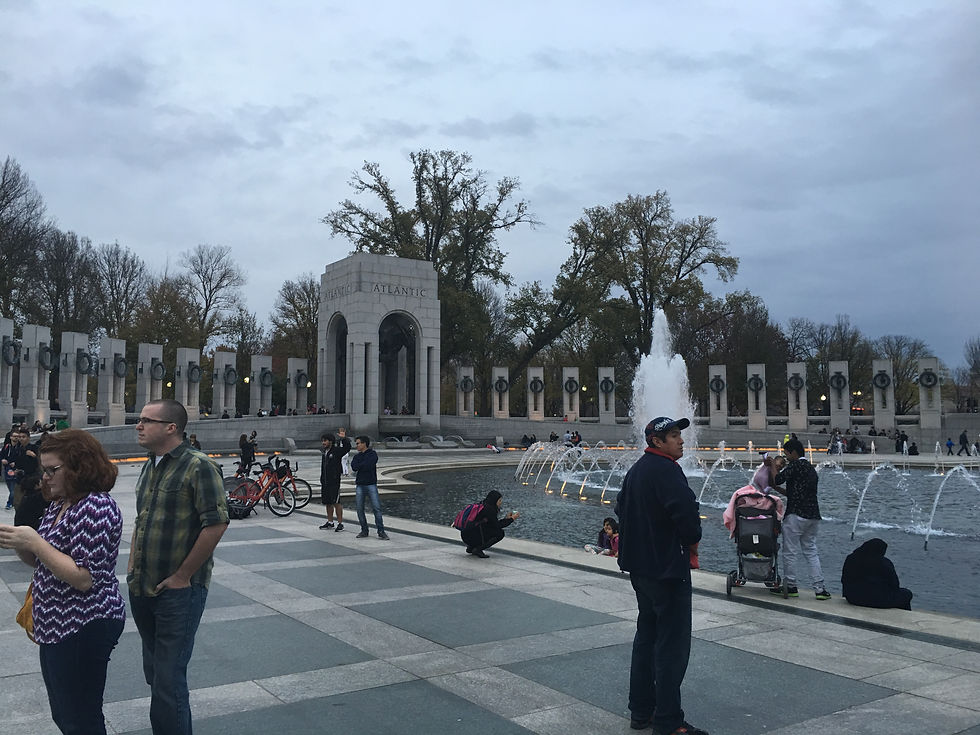

As we move towards the northern arch of the pavilion, we see a large pillar inscribed with “Atlantic” and the southern pillar is inscribed with “Pacific”. After much thought on the manner the only conclusion I can make on the choice of which coast should be north/south, it makes sense that the Pacific be made South since our enemy, the Japanese, are in the southern Pacific, and our European enemies were to our northern Atlantic region. Both pavilions were emblazoned with four bronze eagles holding one wreath. The eagle is America’s symbol of freedom and the wreath symbolizes victory—a symbol from Ancient Greece. Perhaps the four eagles represent the four major military forces: Air Force, Navy, Marines, and Army. Together they uphold our freedoms and our way of life. There are also wreaths posted at each state column and they alternate between wreaths of wheat and wreaths of oak. It was said that wheat represented agriculture and oak represented industry. As aforementioned, agriculture and industry were doing well post-depression in America and as the fruit of our labors, we were able to support our military well.
Within each semi-circle pavilion, there were writings of “Victory at Sea,” “Victory in the Air,” and “Victory on Land.” In the center of these pavilions there is a World War II bronze plaque that has a Roman Woman holding two halves of a broken sword and is standing on a helmet. The lady is very similar to the style of the Virginia state flag, which also features Roman symbolism and conquering.


Underneath the Atlantic and Pacific pavilions there are water features with important dates, battles, and locations from each coast. The Atlantic side features small memorials to North Africa, Western Europe, Southern Europe, and Central Europe. The Pacific side features China, Burma, India, Southwest Pacific, Central Pacific, and North Pacific. In this way, the “world” aspect is introduced into the memorial. On that note, why is it that this entire memorial, a World, war memorial, places so much emphasis on America? Wouldn’t this be a slap in the face to our allies from around the world who may come to visit this memorial to honor the memory of our past? Where is the proper credit to our allies who have fought much longer and sacrificed much more than the American people? Moreso, our nod to the region is very broad. Why not call out our greatest friend, Great Britain? Instead, they are lumped in with Western Europe.


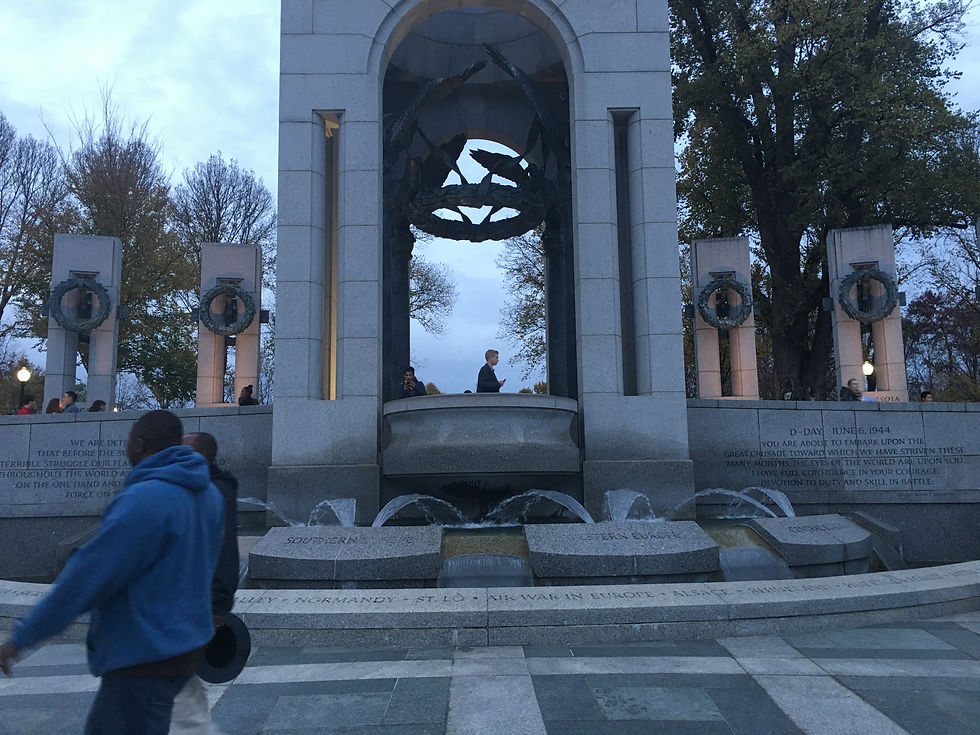


Linking together the entire pavilion and states are two intertwining bronze ropes. At the most elementary level, one can automatically conclude that these ropes symbolize our unity as a nation. On a deeper level, however, we may think on how ropes are a nautical item representing the navy. Our war was fought mostly over seas, indicating that we had to cross oceans to meet our enemy. Further, had it not been for Pearl Harbor, an attack on one of our naval bases in the pacific, America may not have ever entered the war.
Besides the fact that this was an extremely beautiful memorial, and that it instilled a sense of American patriotism, pride, and honor, I was very disappointed in what actually came to be presented in this memorial. I cannot look passed the fact that each state and American territory was so heavily represented. I truly felt that it was disrespectful that there was nearly no acknowledgment of the countries that fought in the war. Let’s forget that fact, for a moment, that the United States had enemies during the war; each side suffered substantial losses, and the fact that not even our allies were proudly recognized almost angered me. I understand that the memorial may be attempting to call attention to the unity of the United States during the war, but I think it was too much that each state had a pillar, and only some of the regions had a slab of stone. I was also disappointed at the fact that there was no presence of the sacrifices or achievements that women made during the war. This reminded me of the exact situation that happened in the National Museum of American History – how there was no presence of the women of war. Still, I cannot help but feel that the grandeur of this memorial serves a mask to broken spirits and losses, and that it was purely made so that people would come and dwell on this terrible past – hence the seating areas. Just one man’s opinion.


At the western entrance of the memorial, there are twenty-four uniquely sculptured reliefs depicting both fronts of the battle.

In the above image of Harry Truman’s quote, it is interesting to note that he may indirectly be implying that our allies took the ultimate blow while we, coming to the fight late, shared in the destruction of the enemy. Little pain, much glory.